
Hoosiers United for Separation of Church and State

Join us for reflection
Perspective Section

A Turning Point
6/3/2026
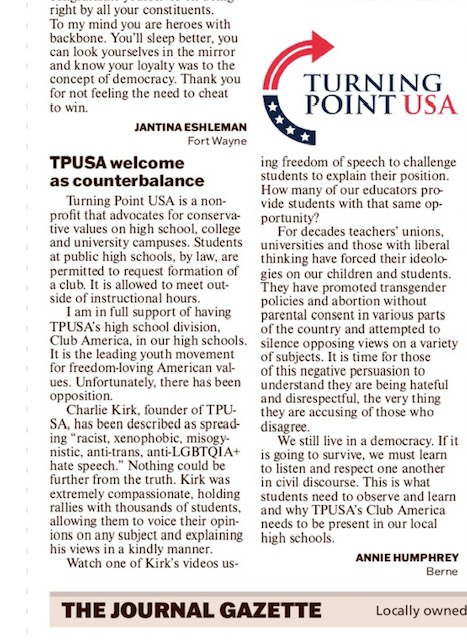
Annie Humphrey’s May 19 letter supporting Turning Point USA’s presence in local high schools presents itself as a defense of free speech and promoting “freedom-loving American values.” But it overlooks several important realities about education, civic discourse and Turning Point itself.
No one is arguing that conservative students should be denied the right to organize. Public schools should protect students’ constitutional rights to form clubs and express differing viewpoints.
In fact, students have always had a constitutional right to form clubs. Gov. Mike Braun had no need to provide a proclamation of this right when he encouraged schools to welcome TPUSA’s Club America.
One of the problems of TPUSA is that Lt. Gov. Micah Beckwith and other Republicans are promoting a highly partisan political organization within our public schools.
Beckwith has said, “We have 290 school corporations in Indiana. We would love to see Club America in every one of those school corporations so that we can promote pro-American values.”
The question is: Whose values? Only Christian nationalist values?
TPUSA founder Charlie Kirk, like Beckwith, was a Christian nationalist. These values do not represent all Americans; in fact, they are highly controversial and partisan and represent a narrow version of Christianity, and frankly only represent a minority of Americans.
In 2024, Braun signed a bill strengthening release time for religious instruction. This has led LifeWise Academy, a partisan corporation targeting elementary schools, to take advantage of release time as a recruiting tool for evangelical Christianity.
Indiana’s top two elected officials should not be pushing partisan organizations such as TPUSA, LifeWise Academy, and a particular theology on Hoosiers, and they especially should not be imposing them in our public schools.
Religious extremism has no place in our school systems. Criticism of TPUSA is not censorship. Disagreement is not “silencing.” Communities are allowed to object when political partisans target schoolchildren.
Humphrey buys into the talking point that “liberal-thinking” teachers’ unions and universities are indoctrinating children. This couldn’t be further from the truth.
The teachers I know dedicate their lives to creating respectful learning environments where children can think critically and engage with others not like them. This is preparing children for a wider world where they and American democracy can thrive.
To try to narrow a child’s worldview is a disservice to us all. Like it or not, diversity is here to stay.
Humphrey calls for civility while at the same time describing those with opposing views as hateful and disrespectful.
True civil discourse requires more than claiming victimhood or framing disagreement as persecution. It requires intellectual honesty, accountability and a willingness to engage facts rather than stereotypes.
Hoosier students deserve opportunities to think critically, examine evidence and engage respectfully with many viewpoints. What they do not need is elected officials treating schools like recruiting grounds for political movements.
Free speech belongs to everyone. State-sponsored favoritism toward one political or religious organization does not.To read the letter to the editor that inspired this piece click Here ->
Tammy Pulford
Member, Hoosiers United Board

State “leaders” fail to challenge Beckwith’s bigotry
5/29/2026
Now you have it straight from Micah Beckwith, Indiana’s self-styled Christian nationalist lieutenant governor, that he hates Islam. Rather than backing off his recent statement that Islam is a “demonic death cult,” he is ratcheting up his hate campaign on Facebook and probably other media. The man loves to be in the center of attention.
Which probably means he would enjoy reading this, so let’s broaden the focus.
Do Mike Braun, Todd Rokita, Todd Young, Jim Banks and Marlin Stutzman also hate Islam? Or are they just OK with Beckwith ranting again?
As I write this, it’s been more than a day since the news broke that Beckwith trashed the faith of about 2 billion people. I have found no public response by our governor, our state attorney general, our two U.S. senators and our local U.S. representative. None.
And, actually, Beckwith proclaimed his hatred more than a week ago, on the conservative Christian program FlashPoint. I have to believe several of those silent “public servants,” all of whom rely on Christian nationalist voters, knew what Beckwith said long before the general public did.
Yet, all these professing Christians remain quiet although Beckwith not only spewed sectarian bigotry, but did so wearing a shirt with the insignia of Indiana’s lieutenant governor.
He linked all of us in Indiana with his perverted vision. His is the face of theocracy in the making — one religion to rule us all.
In a way, this Indiana embarrassment is old news — just Beckwith trying harder and harder to be outrageous and somehow relevant. And maybe it is old news that those other politicians are silent, but it is still important news. If they won’t come together to condemn what Beckwith is saying and doing, who in Indiana leadership will?
Beckwith has given all these people a fine opportunity to separate themselves from the warlike agenda driving Christian nationalism, but, so far, they are afraid to do it.
Evan Davis
Member, Hoosiers United Board

Americans United suing the U.S. Department of Agriculture
5/15/2026
If it sounds bizarre that Americans United for the Separation of Church and State is suing the U.S. Department of Agriculture and its secretary, it is only because the Trump administration is so dangerously bizarre.
Secretary Brooke Rollins sent an Easter email to more than 100,000 USDA employees declaring “our faith” that “Jesus has been raised from the dead.” Americans United is suing Rollins for violating the separation of church and state enshrined in the “no establishment of religion” clause of the First Amendment.
The central legal question, I suppose, will be how the opening phrase of the First Amendment, “Congress shall make no law …”, should be interpreted. It is not Congress that sent the emails.
And it is the White House, not Congress, that has announced a day-long prayer festival to rededicate the United States as “one nation under God.” That phrase, of course, has nothing to do with the founding of our country and our form of government. It was added to the Pledge of Allegiance in 1954 as part of the Cold War rhetoric against the Soviet Union.
These two events are among many violations of the spirit of church/state separation that have occurred since Trump returned to office. The most notorious is probably the Christian prayer offered by Secretary of Defense Pete Hegseth to justify extreme violence against Iran.
I presume the legal case against Rollins will center on her creating a threatening atmosphere for public employees who do not share “our faith.” You have to be pretty dense to get an email like that from your boss and not understand that she is expecting you to acquiesce to her establishing an atmosphere of a particular religion within a department of the federal government. At the very least, she is insulting unbelieving members of her staff; at the worst, she is threatening their careers if they choose to object to her crude behavior.
The whole oppressive authoritarian atmosphere exemplified by these events is rooted in the power right-wing Christian authoritarians have gained over Trump with their crucial political support for him. The result for all of us, so far, is not yet an establishment of religion but certainly a disestablishment of the norms of American political behavior that have protected all of us from political overreach by advocates of any religion. The authoritarians still have 32 months to make things worse.
Evan Davis
Member, Hoosiers United Board

Self-Evident Truth
5/7/2026
The comments in Dave Cooper’s April 23 op-ed, “Church/state separation pollutes political thought,” gave me pause.
Cooper would do well to refrain from using quotes completely out of context, and to check his facts more carefully since some of those quotes were incorrectly attributed. Quotes with no reference to time or purpose do not prove a point but serve only to confuse or manipulate.
One point Cooper is missing is that it does not matter what personal religious beliefs the founders and framers of the Constitution held.
What matters is their ideas about how those beliefs should play out in the structuring of our government and the application of that structure to the people.
The founders did not imply that religious or moral ideals should never play a part in determining policy and procedure.
They were advocating against establishing one true religious ideal as the sole influence.
They make that perfectly clear in many places, but the two most easily referenced and understood are the First Amendment to the Constitution and the Treaty of Tripoli.
The First Amendment of 10 ratified in the Bill of Rights begins: “Congress shall make no law respecting an establishment of religion, or prohibiting the free exercise thereof …”
Reading about the debates that occurred during the ratification period, you can see that addressing freedom of religion in the very first words in the Bill of Rights is no accident.
Simply put, the clause says government cannot make any laws favoring one religion or saying one religion is the state religion. The second clause says government cannot stop people from practicing their religion, no matter what it is.
Pretty clear.
The Treaty of Tripoli was written by a Jeffersonian republican and signed in 1796, just seven years after the ratification of the Constitution. This treaty was ratified unanimously and without debate by the Senate and signed by President John Adams.
Article 11 states: “The Government of the United States of America is not in any sense founded on the Christian religion.”
Looking at these early documents, the writings of the leaders of the founding era, and following the history of the country for the subsequent 250 years, it seems clear that this is a country with a lot of Christians, but it is not a Christian country.
Intentionally.
We should also note that although the word “God” does appear in some writings of the era, it does not appear anywhere in the Constitution, and the Declaration of Independence carefully used the word “Creator.”
The religious right’s worldview often conflates any mention of God to Christianity, giving a very narrow interpretation to many writings.
Cooper implies that cruelties committed by Iran and ISIS are justification for establishing Christian ideals in the U.S. What he is missing is that religious authoritarianism eventually leads to oppression of the “other” no matter what the state religion is.
Compared to many of the European nations that have had state religions in the past 250 years, many of them Christian, the United States has long had a higher level of religious enthusiasm.
Religious authoritarianism breeds more authoritarianism and leads to division and “othering” of the people.
The religious right loves to malign the phrase “wall of separation,” citing that it was “just in a letter.” It amuses me to think that these are the same people who revere the books of the Christian Bible referred to as the Epistles: Galatians, Romans, Corinthians and other books. Contextually, these were letters written by a disciple named Paul and aimed at a particular group of people in a particular geographic area and had a specific purpose for their writing.
Could we offer the same respect to that letter of Thomas Jefferson’s? Context matters.
To read the Op-Ed by Dave Cooper that inspired this writing Click here →
Rebecca Reeder
Member, Hoosiers United Board

Calvinism on the rise
4/5/2026
Here we are in the second quarter of the 21st century and Americans are still wrestling with the question of whether we should be ruled by people who say they represent human beings or by people who say they represent God.
You might have thought ten years ago that question had been resolved in favor of human beings, but that was before Donald Trump was first elected, largely with the support of Christian nationalists. And it was well before most of us had even heard of Doug Wilson, the Idaho-based Calvinist preacher who has risen to celebrity status with Trump’s second coming.
If you are not familiar with Calvinism, it is a strict form of Christianity that includes the notion of predestination — that God decided long ago whether you will go to Heaven or Hell. Its origin is the theocratic rule of John Calvin in Geneva, Switzerland during the early years of the Reformation. One of Calvin’s most infamous acts was promoting the prosecution of Michael Servetus for heresy, which led to the latter being burned at the stake.
Wilson asserts that he prefers divine rule over rule by human beings, but, of course, “divine rule” always means rule by human beings who say they are following divine orders. If Wilson and those like him ever gain the kind of power held by Iranian mullahs, their similarities will be more important than their differences.
Speaking of Iran, Wilson’s most prominent follower is Pete Hegseth, the secretary of defense (self-styed secretary of war) who urged Americans to pray for victory in the war against Iran “in the name of Jesus Christ.” His 2020 book American Crusade includes harsh attacks on Islam along with many other groups, including American “leftists.”
Here is a quote from the Wikipedia article about Hegseth’s book: “Hegseth says he believes there are ‘irreconcilable differences between the Left and the Right in America leading to perpetual conflict that cannot be resolved through the political process’. He furthermore calls for an ‘American crusade’; he says the ‘hour is late for America. Beyond political success, her fate relies on exorcising the leftist specter dominating education, religion, and culture – a 360-degree holy war for the righteous cause of human freedom”. There they are — a preacher who would rule in God’s name and his crusading acolyte who runs the most powerful military force that has ever existed. Maybe you never imagined such a combination of zealotry and power in the United States, but now you don’t have to. It already exists.
Evan Davis
Member, Hoosiers United Board

Religious beliefs vs. civil rights
3/9/2026
The Brownsburg, Indiana school corporation is the latest victim of the notion that “religious liberty” means you may be at liberty to ignore public laws and regulations, as long as you can persuade a court that you are doing it because of your sincerely held religious belief.
Last week, the news broke that the school district agreed to pay $650,000 to one of its former teachers who had resigned after refusing to address a transgender student by the student’s self-chosen name. The teacher, John Kluge, sued under Title VII of the Civil Rights Act, which prohibits, among other things, religious discrimination against employees. He was supported by Alliance Defending Freedom, which has made itself a big name by asserting religious exemptions to public policies.
Note that the school district had not restricted Kluge because of his religious beliefs — it attempted to limit what he could do with his religious beliefs in regard to students.
Another federal law, the Religious Freedom Restoration Act, was cited 12 years ago to let Hobby Lobby deny insurance coverage for an abortifacient contraceptive because of the company owners’ religious beliefs.
So, in both cases, religious freedom was interpreted to exempt one party from legally established expectations of behavior to another party
The United States Constitution protects free exercise of religion, and the crunch word there is “exercise.” Earlier courts ruled that people cannot exercise their religious beliefs to legally use cannabis or peyote in religious rituals, even though such use is not violating the rights of anyone else. In other situations, men have been able to exercise their religious beliefs as conscientious objectors to not be drafted into the military but have been required to do public service instead.
It seems to me that cases like Brownsburg and Hobby Lobby are moving America away from a concept of equality under the law. When one party can persuade the court that their religious beliefs are more important than the civil rights of the other parties, then that is not equality. Refusing to address a child by the child’s chosen name because of a religious belief sounds pretty close to refusing to serve a customer because he is boasting a devilish tattoo or because she is wearing a hijab — or, as we know all too well, because of “the curse of Ham.”
Correct me if I’m wrong, but my belief is that this recent trans-bashing phenomenon is based much more in contemporary politics than in established religious tenets. Richly endowed groups such as Alliance Defending Freedom are using religious notions to exert political power, and like women seeking emergency abortions, trans children are easy targets.
If using the convenient weapon of theology to mistreat another person is allowed to become the norm, then it defiles the traditional American concept of religious liberty.
Evan Davis
Member, Hoosiers United Board
Christian Values
by Jim Boeglin
January 21, 2026
Hoosiers United for Separation of Church and State respects and appreciates traditional Christian values that are based on the teachings of Jesus. Working to maintain separate roles for church and state does not make us an “anti-Christian” organization. We are, however,
opposed to the politically-motivated attempts of some Christian nationals to forcibly impose their conservative interpretation of Christianity upon all Americans and every aspect of American life.
What are the Christian values in which we believe?
- We believe America is a pluralistic society made up of diverse religious and ethnic backgrounds, all of which are deserving of the Constitutionally guaranteed freedoms, including freedom of religion;
- We believe all Americans, regardless of skin color, ethnicity, religion, or gender expression are entitled to equality, and that no group, class, race, gender, or religion is “privileged”;
- We believe the very concept of white supremacy is anti-Christian;
- We believe “Justice for all” is not just an etching on the facade of the Supreme Court building;
- We believe a democratic form of government “of and for the people” is a more just option than an authoritarian state, oligarchy, or theocracy;
- We believe everyone in America is entitled to the protections of due process, and that citizens and non-citizens alike are entitled to respect and kindness;
- We believe the military, and federal, state, and local law enforcement officials are public servants and fellow citizens, rather than weapons for government oppression;
- We believe openly welcoming strangers and loving kindness are hallmarks of Christianity;
- We believe helping one another is what Jesus modeled and expected from his followers;
- We believe until all are free, none of us are free;
- We believe decency, civility, honesty and integrity are the foundation on which a just society are built; and
- We believe fear, greed, violence, cruelty, lust for power and control over others, are the antithesis of Christian values.